Disabled parking placard applications, the doctor’s part
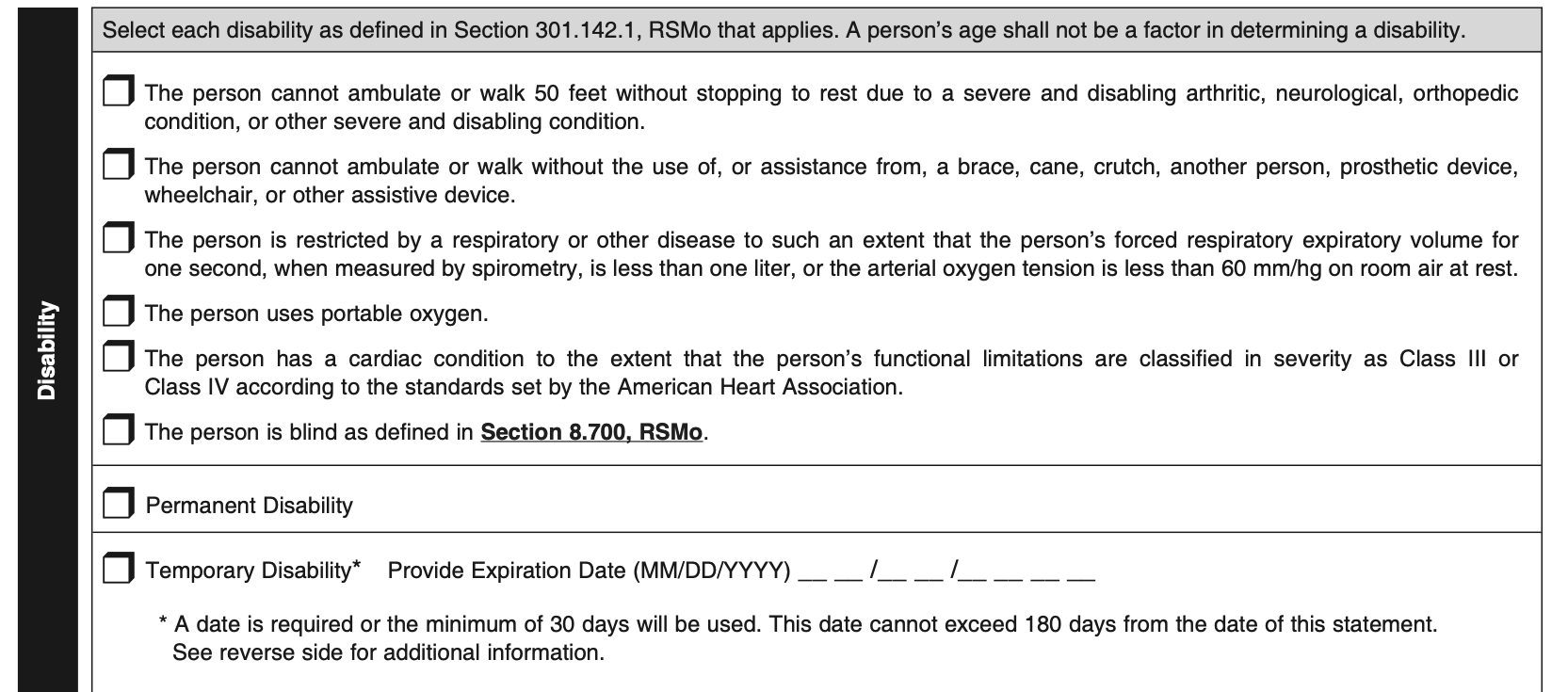
A patient asks for a parking placard at the end of the visit. In Missouri the statement is one page and takes two minutes, but it is a misdemeanor to sign it for a condition that is not on the printed list, and every state’s list is different.
 Kevin Lease, MD·Internal medicine, primary care·October 2026
- Forms
- one for each state and the District of Columbia, from that state’s placard office, usually its motor vehicle office
- The rule
- each state’s own statute, and, on most forms, the list printed there
- State walkthroughs
- California, Florida, Georgia, Illinois, Missouri, New Jersey, New York, North Carolina, Ohio, Pennsylvania, Texas and Virginia
Key points
- A state or local office issues the placard. It relies on your statement, not its own exam.
- Your patient must meet a condition on that state’s list.
- The walking distance is usually 200 feet. Four state forms print 100, and Missouri’s prints 50.
- Sign it yourself, and keep the note that supports it in the chart.
Once you know what the state is asking you to certify, PatientPapers, the app I built, can fill in your part of each state's placard form, or write the letter where a state asks for one, for you to review and sign.
See the parking forms PatientPapers completesWhat the state is asking you
A state or local office issues the placard, and nobody there examines your patient. What the office relies on is a clinician’s statement that the patient meets one of the conditions in the state’s law. So when a patient asks you for one, the question is not whether a closer parking space would make life easier. It is whether they fit a definition the legislature wrote, and in most states that definition is printed on the form you are signing.
That is why I treat it differently from most paperwork. Several states print a penalty for a false statement on the form itself. Missouri makes it a misdemeanor to certify someone who does not meet the list, and New York’s form warns that a false statement on the application is a crime. So the habit I would suggest is the same everywhere. Read the list on the form in front of you, or the statute it cites, check only what your examination supports, and put the note that supports it in the chart.
The rule: each state’s own statute. The state walkthroughs below cite theirs.
What changes at the state line
Every state and the District of Columbia has its own form. Most print the list, and it usually tracks the state’s law. Where a form only cites a statute, I read the statute. The walking distance changes the most. Of the state forms I have read that print one, most say 200 feet. Arkansas, Kansas, New Mexico and South Carolina say 100, and Missouri says 50. After that, what changes is whether the state wants a diagnosis or only a check, whether it offers a temporary placard and for how long, who may sign, and whether your part is a box on the state’s form, a letter, or a signature in front of a notary.
Twelve states side by side
| State | Your part | Walking distance, one condition among others |
|---|---|---|
| California | Section 5, then Sections 6 and 6A, of the REG 195 | None, it lists conditions instead |
| Florida | Section 2, the Statement of Certification, of the HSMV 83039 | 200 feet |
| Georgia | Section D of the MV-9D, notarized or on security paper | 200 feet |
| Illinois | Part 3 of the VSD 62, and Part 4 for a meter-exempt placard | 200 feet in Part 3, 20 feet in Part 4, each one box among several |
| Missouri | Form 1776, which your patient files within 90 days | 50 feet |
| New Jersey | A letter attached to the SP-41, and you also fill out and sign Section E | 200 feet |
| New York | Part 2 of the MV-664.1 | 200 feet |
| North Carolina | The Medical Provider’s Section of the MVR-37A | 200 feet |
| Ohio | A prescription sent with the BMV 4826, not a box on the form | 200 feet |
| Pennsylvania | Section B of the MV-145A, with a reason code | 200 feet |
| Texas | The VTR-214, notarized or with a prescription | 200 feet |
| Virginia | Page 2 of the MED 10 | 200 feet |
Who may sign, how long a temporary placard lasts, and where the patient takes the form differ too, and each state’s walkthrough covers them. For the other states and the District of Columbia, the form is usually on the state’s motor vehicle office website, and the same habit applies.
Questions the office asks
What does a doctor certify on a handicap placard form?
The clinician who signs certifies that the patient meets one of the conditions in the state’s law. A state or local office issues the placard, and nobody there examines your patient, so that statement is what the office relies on.
How far must a patient be unable to walk to qualify for a disabled parking placard?
It is usually 200 feet, on most of the state forms I have read that print one. Arkansas, Kansas, New Mexico and South Carolina say 100, and Missouri says 50.
Can a doctor get in trouble for signing a disabled parking placard form?
Yes, for a false statement. Several states print a penalty on the form itself. Missouri makes it a misdemeanor to certify someone who does not meet the list, and New York’s form warns that a false statement on the application is a crime.
Is the disabled parking placard form the same in every state?
No. Every state and the District of Columbia has its own form. Most print the list, and it usually tracks the state’s law. Where a form only cites a statute, I read the statute. Your patient must meet a condition on that state’s list.